Locations


I was going to write about the tactical model I’ve developed, but it apparently needs some more refinement. I’m attempting to have it done by the end of this week (Grand Prix: Worcester). What happened was that recent stress tests via thought experiments revealed some holes that I wasn’t happy with. The model handles these situations, but in a counterintuitive and inelegant manner, which is something I’m looking to avoid. However, those ideas did give me something to write about: the anatomy of a play.
The primary purpose of a tactical model is to break down plays, telling the player what is “good” or “bad.” In essence, it is a measure of efficiency, and it should be able to tell a player when to apply certain concepts such as card advantage, time, and the Philosophy of Fire. But Magic is a complicated game, and often, the goals and objectives of a situation are muddled by variance. Let’s do a thought experiment.
Situation:
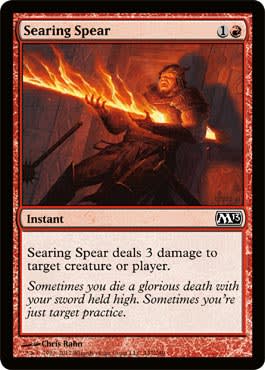
However, your deck has a weakness to flyers, a weakness your opponent exploited to tie the matchup 1–1. You have only the following cards to deal with flyers directly: two Searing Spear, one Prey Upon, and one Deadly Recluse. Assuming you can force your opponent to block with his flyers, you have one Show of Valor and one Titanic Growth to help out. Otherwise, you’re relying on your beefy ground army (including Odric, Master Tactician and Captain of the Watch) alongside two Rancors to get there. Your only creature with flying is a singleton Battleflight Eagle.
You were seated next to your opponent last round and know he has access to the following cards: three Talrand's Invocation, one Archaeomancer, two Faerie Invaders, one Welkin Tern, two Wind Drake, one Furnace Whelp, and one Thundermaw Hellkite. He may or may not have a couple more flyers lurking in his deck, but it is very clear that his assault is going to be flyer-based. You also know that your opponent has access to at least one copy each of Searing Spear, Essence Scatter, Volcanic Geyser, Sleep, and Downpour to help him win races.

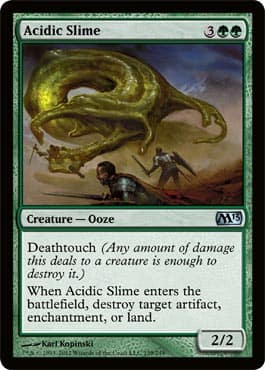
Your fourth turn rolls around, and you draw Prized Elephant. You play your Plains and are faced with a decision: You can play the Prized Elephant you just drew (superior to the option of playing the Spiked Baloth in your hand) or you can play the Acidic Slime you were holding. After some deliberation, you choose to play the Acidic Slime.
You have two options: The safe option is blowing up his Ring of Evos Isle, and the aggressive option is blowing up his Island in hopes of keeping him off  for Talrand's Invocation, Sleep, and Archaeomancer while delaying his more expensive flyers further.
Examining the Play
Why would you want to blow up the Ring of Evos Isle? Well, it’s already equipped to a flyer for which you have no direct answer. The Welkin Tern has already hit you for 2 and is lethal by itself in four more swings. You might not be able to race that if your opponent has removal or even something like Downpour—and definitely not Sleep. Thus, if you blow up the Ring of Evos Isle, you guarantee yourself more turns as you cut the Welkin Tern’s clock from four turns to nine turns—a significant reduction indeed. This will allow you to get your powerful ground forces online.
Why would you want to blow up the Island? Your opponent has quite a few spells, and his 4-drops are especially powerful. Delaying his 4-drops by a turn or potentially cutting them off entirely is an awesome result. If you blow up the Island and your opponent doesn’t have a third, it’s reasonably likely you will win the game easily. Free wins are free wins.
So, what goes into making this decision? What factors do we need to consider before we choose between Ring of Evos Isle and Island? These are four important factors:

- Deck composition – What options are we leaving our opponent in each situation, and which is better for us? We have already considered this to some extent even by reaching this point, as blowing up the Island is much worse if our opponent’s deck is not full of such powerful spells.
- Opponent’s hand – What is he likely to be holding? If he has something like two copies of Talrand's Invocation and a 5-drop with only one Island and no more lands, he might just be completely boned. On the other hand, if he has Essence Scatter, Downpour, a Wind Drake, and one Island, he might very well be okay. Furthermore, if he’s holding any hand with two more Islands, he can easily pull ahead of you.
- Opponent’s play style – How likely is it that the opponent had other options on turn three other than playing the Ring and equipping it? Would he have held up Essence Scatter if he had it? What about simply playing out another creature like a Wind Drake or a blocker like Augur of Bolas or Scroll Thief? While you have very good information about his deck, you don’t have perfect information, so what else could he have potentially done? This play looks a tad different depending on if your opponent is a naturally controlling or naturally aggressive player. A highly aggressive player might make this play over another equally good defensive option, meaning he could still do something worthwhile next turn.
- Draws – What can you draw to improve your position in each case? What are your opponent’s draws that hurt you in each case, and how much do they hurt?
The key to these is that they are all impacted by imperfect information. For example, the exact composition of your opponent’s deck can make a huge difference one way or another, and not knowing can mean the difference between winning and losing. Consider a format like Legacy. If you are playing a Show and Tell deck against Maverick and he has an active Knight of the Reliquary, do you go for Emrakul even though he could have a Maze of Ith? It’s a singleton that not all Maverick lists run, but if it shows up, it will utterly blow you out in that situation.

Magic has often been likened to another game involving imperfect information: poker (generally Texas Hold’em). While they do share similarities, there is one critical difference: Poker can be played mathematically. The concept of pot odds can tell you without making a read on your opponent what the chances are that any given bet or call is profitable. It can be influenced by the number of potential outs that exist in the situation at hand, but the effect and likelihood that those outs are hit can also be calculated and factored in.
So, why can you do this with poker and not with Magic? The answer lies in complexity. In poker, there are a very limited number of outcomes. Any individual hand really only has a small subset of potential interactions that a player has to worry about, and you can actually play enough hands of three of a kind against a flush draw to make the odds even out. Thus, the math is actually helpful.

All in all, many aspects of decision-making that a Magic player makes are based upon supposed information. In other words, it’s based upon assumptions and things of that nature. This is among the reasons that rogue decks are so powerful. By playing something rogue, your opponent is able to make fewer assumptions and suppositions about your strategy and probable play lines, thus giving you an advantage.
Conclusion
All in all, the impact of information is quite larger than most people think. It’s among the reasons that cards such as Vendilion Clique, which come with virtually free information attached, are so powerful. You might very well see the impact of this first hand with the rotation, as Delver of Secrets will no longer have Gitaxian Probe to help it out. No doubt the loss of Mana Leak will be felt as well, but Gitaxian Probe is among Delver’s strongest early plays because of the information it provides. The loss will hurt Delver arguably as much as the loss of Mana Leak.
Next time you sit down at the table, consider for a moment how what you know—and more importantly, what you don’t know—impact the decisions that you make. Maybe next time you analyze a play (probably while complaining to your friends about how you lost), you’ll think about how unknown factors make as big of a deal as known ones.
Chingsung Chang
Conelead most everywhere and on MTGO
Khan32k5 at gmail dot com